


Note: This is a review of an ARC, so I can’t quote directly from the book. All opinions are my own. Thank you to Simon & Schuster/Saga Press and NetGalley for the ARC. You can pre-order the book here.
“For the mental universe of the extreme trauma survivor is [sic] a place where trusting someone is not an option, and where the genius of one’s own imagination becomes an inescapable stalker. In such a landscape, whenever the inhabitant becomes so bone-weary that she lets down her guard a little, the memory cabinet door swings open to reveal precisely the thing she cannot endure. Letting down her guard is at once what she most achingly desires and what she most vigilantly avoids.
—Martha Stout, Phd. in The Myth of Sanity: Divided Consciousness and the Promise of Awareness
The first lesbian novel is a drag. I first had to slog through this overwrought, self-pitying text for an undergraduate seminar on Queer British History. Even understanding that being a 20th century invert probably sucked, I grew sick of Stephen’s baroque Victorian whining. Stephen, you’re a best-selling novelist with an in-home servant, a community, and a wonderful partner—why are you giving your femme away to a man and slipping into “the well of loneliness” of your forerunners?
My professor posed this question: Why would Radclyffe Hall, a popular fixture in the Paris queer scene of her time, who had a thriving social and romantic life, write such an unrelentingly miserable, self-destructive, and lonely character?
Let’s posit trauma—trauma re-cycled through the imaginary, creative act of penning the novel. The “trauma plot” has been done to death and back, but Trans Literary It-Girl Nominee Grace Byron knows this. She says in her Literary It-Girl interview for Cultured Mag: “Okay, you want the trans girl sob story? I’m going to give it to you, but in an aggressive way.” Hers, related “bitterly,” is one of a Christian childhood with conversion therapy, followed by an adulthood of abusive relationships, addiction, and thwarted art dreams—a classic frauenroman.
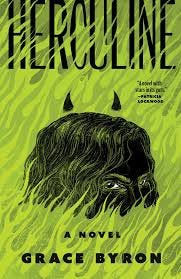
Byron’s forthcoming Herculine is in line with the lesbian novelist’s tendency to color their protagonist’s subjectivity with past-gazing misery—but this time, the trauma-plot lens is blurred with dissociative status-seeking. Networking, in clipped sentence fragments, with Trans Girl Freelancers and Famous Actresses. No amount of love nor sex nor change of scenery provides a reprieve from the interchangeable, shadowy daemons, nor the flat affect. If Valencia’s dream was to “run through the streets in excellent danger,” Herculine’s is to limp down the block with one hand over your swollen left eye. This is the New Lesbian Gothic; a sign of the times.
Herculine’s protagonist wakes up depressed and does ketamine before going to a shift at the job she hates, where she is shitcanned. She goes to parties depressed, where she judges other trans women and does more ket. She hallucinates depressing things that provoke the reader to wonder if perhaps this lady needs a T-break. Rather than going to rural Indiana to dry out, she travels from one trans woman T4T/dyke-drama drenched scene to another. It could be said that the cult at Herculine represents an escape from the cis world, but the trans women who populate the cult at Herculine could be uncanny doubles of the trans women clique of Byron’s New York City (the only difference is, there’s no t-boy dick at the commune). There is no point in the novel at which the protagonist stops reflecting on clout—the bylines, the book deals, the cultural caché, the hot girl surgeries. It’s like Shirley Jackson’s hallucinatory sensibilities merged with Eve Babitz’s willingness to exit the house.
Herculine is ostensibly about the recovery from religious and relational trauma—but, like all debut novels, it is also about the trauma of publishing a first novel. Unfortunately, the protagonist does not sell her soul to Dagon for a book deal1. Dissociation is inaction as a survival tactic. Thus we get a book about a character floating around hypothetical, gauzily-realized horror settings while rarely being fully present in them. Ritual sacrifice? Time to step out for a cigarette break and think about my childhood.
While not as camp as this reviewer would’ve liked, Herculine is definitely écriture féminine. Mary Gaitskill has a line somewhere about the bourgeois, upper-class, suburban white woman turning her subjectivity inward. Though she will angst over this tendency, she rarely refrains from her urge to follow rules on the traditional path to social success. If those can’t be the rules of Christianity or traditional cishet society, they will become those new, invented ones of a subculture. Though clearly plagued by them, Herculine does not ultimately find a vision in which such rules are absent.
Gretchen Felker-Martin’s Manhunt (2022), one comp, was a lodestar for queer horror writers. I fucking loved it. It was camp, chronically online, gory, genuinely shocking, and (so far as I know) genuinely different from anything else out there. Felker-Martin integrated the online and material concerns of trans women into the nature of the world itself—a vividly-rendered dystopian future where males exist as mutated monsters (trans women must harvest estrogen to survive) and cis women band together as militant political lesbian TERFs (clocky trans men must hide or be killed); a world where rhetoric hitherto only seen in the most femcel corners of the-website-formerly-known-as-Twitter materializes in real rape and violence.2 There is much to offend in these pages (for instance, hordes of cis women raping trans women, logistics explained), but meaningful satire offends someone, if not everyone.
By contrast to the blown-out apocalyptic future of Manhunt, Herculine is much in our real world. The trans-woman separatist commune is inspired by real-life lesbian separatist communes that still exist, comprised entirely of dying elders, in places like Vermont and British Columbia (I still comb the ads of Lesbian Connection to find postings for these, and I’d love to interview some members this summer). The 1970s-1990s brand of lesbian feminism, replete in the imaginary with Neo-Pagan menstrual blood rituals and anarchist wimmin’s liberation politics, is decidedly unpopular amongst younger dyke generations. The XX Amazons are probably all at least sixty. Female-centric spaces and yonic imagery have been appropriated in the culture war by right-wingers (so-called “TERFS”3 or, somehow even cornier, the “gender critical”), but many lesbians historically pushed back against the “womyn-born-womyn” mandate infamously enforced in lesbian separatist spaces—Julia Golda Harris’s 3-part On the Land series should be required reading for those who want to write on this topic. Today, The Land on which MichFest thrived still exists, but the festivals are markedly less popular (source—I bought tickets last year and couldn’t go, but still get emails begging for money). Though We Want the Land Coalition still hosts “specifically female” events such as Big Mouth Girl, it also hosts Fern Fest, an explicitly trans-inclusive event.
Sadly, Herculine does not play with this herstory as much as it could. I would have loved a Manhunt-esque satire scene of reverse-transvestigation (like, if a cis woman with a full beard from PCOS was exposed by the evil Ash for her bio-pussy). Unfortunately, even before the charismatic leader of the Herculine commune is revealed to be a charlatan recruiting traumatized women to grow her polycule, she doesn’t seem to have all that much to say on her own anarchist separatist politics. Her witchcraft makes The Craft (1996) look like a recovered Aleister Crowley first edition—our narrator, having Christian trauma, is not eager to become a practitioner of the arts.
I’d compare Herculine to Ling Ma’s Severance (2019), a novel which eerily portended the pandemic, but which didn’t seem all that interested in its own zombie apocalypse world. Like Herculine, Severence is most insightful and engaging when gripped by dissociative flashbacks, musing on identity (diaspora Chinese-American, in that case) and the numb, cloistered, over-priced mundanity of modern New York living. The genre fiction elements seem like an afterthought for the sake of a “high concept” pitch: with all the potentially shocking content matter, I was most aghast when the narrator pathologized the act of reading novels as “dissociative.”
To be fair, shit works. Grace Byron is so Julia right now. She has about as much literary success as any queer, young-ish writer could aspire to in our post-literate world (I’ll admit it, I seethe!). The author seems prolific enough, so why is her debut novel’s protagonist too self-conscious to write much of anything?4
The acts of self-definition and creation (e.g., writing fiction) are, indeed, the way to stop the cycle of trauma. Artistic creation is a purge—even when you do it for zero followers5. Thus our trauma fiction should feel cathartic—not mired. The rebirth of the Gothic genre in popular fiction signals an empire in decline—and what a time to document the incestuous, crumbling elite and the microcosmic horrors within their domestic spaces!
Personally, I’ve always liked the classic ending of the Gothic—the house, and everyone in it, burns down.
and that, dear reader, is the manuscript you hold in your hand right now!
The other comp is nothing like this—Carmen Maria Machado’s much-lauded In the Dream House is self-conscious sapphic “what if we entered me into The Archives” stuff—a series of MFA lit-crit essays masquerading as “experimental” genre work. (this didn’t fit in the essay but I can’t resist the urge to bag on Machado)
I object to “TERF” on the grounds that trans-hating bio-women are so rarely feminists, let alone radical feminists. Even the ones who try to claim feminist rhetoric almost never uplift any women, and we should not let Essentialist trad-wives co-opt “radical feminism.”
Technically she boasts one online unpaid publication of which she is not proud.
or thirty-two—heyyyy guys!